Showing posts with label Regimental history. Show all posts

Tuesday, July 19, 2016

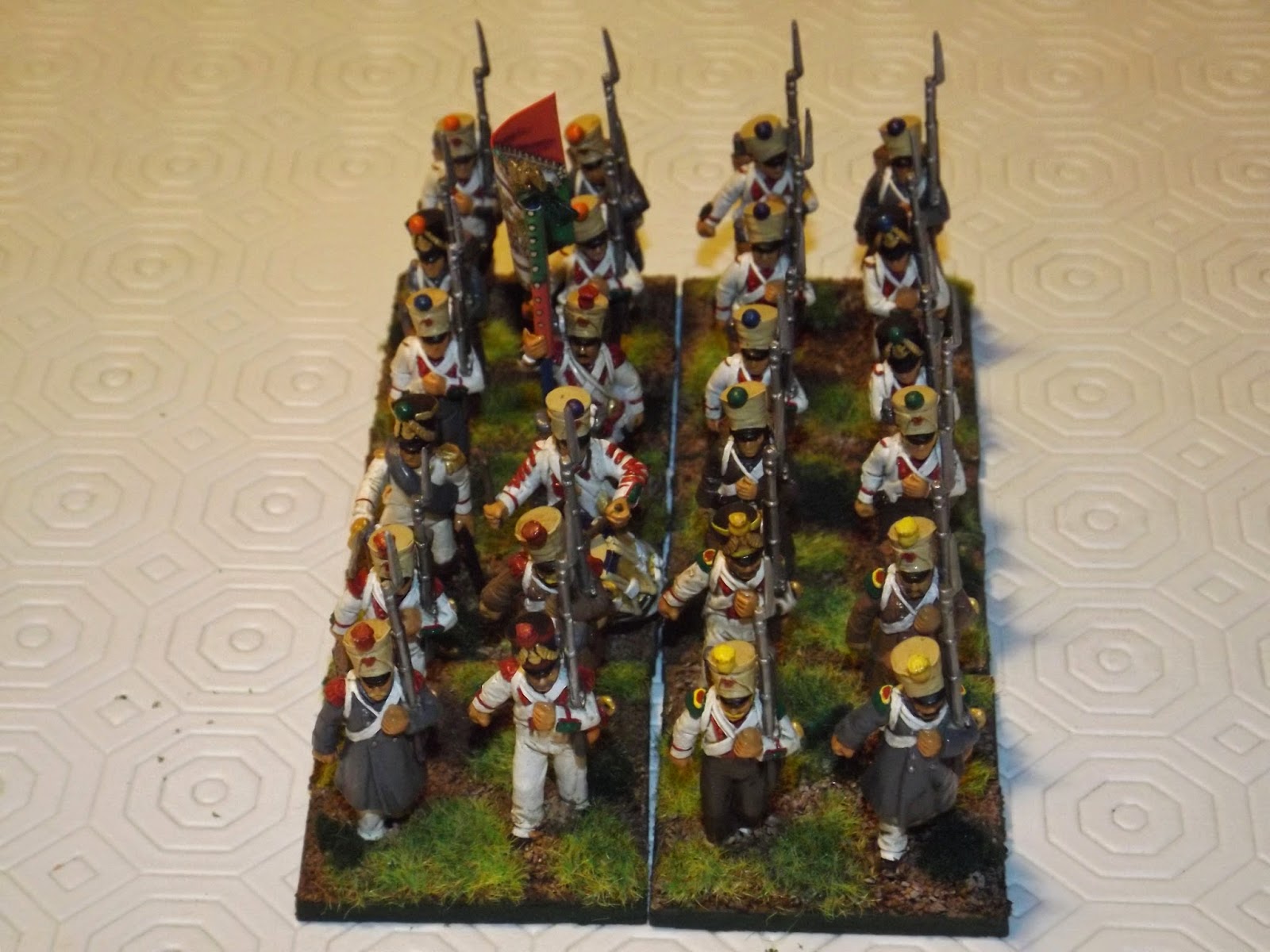
2eme Regiment Suisse, 3eme bon.

The regiment was composed of three battalions that started the war scattered through the entire Peninsula. I’m going to explain each battalion in detail. 

1st Bon.

1808
Was at Vitoria with 1174 men. Corps Dupont, 3rd dv. Frere, 1st brg. Godinot.

April: Moved to El Escorial.

June: Action at Valencia (28/06).

July/August: moves from Madrid to Burgos (831 men).

September: Fights at Osma (12/09) and Oña (21/09).

November: Fights at Gamonal or Battle of Burgos (10/11) in the 2nd Corps of Soult, 2nd dv. Merle, Lefebvre brg. Then moves from Reinosa to Santander (15/11).

December: At Leon with 644 men.

1809

January: Present at Corunna (16/11) but does not take an active role in the fight because the battalion has left several garrisons on the road. Fights at El Ferrol (24/01) losing two officers.

March: Enters at Portugal with the 2nd Corps (Soult), 2nd dv. Mermet, Jardon Brg. Fights at Chaves (25/03) and Oporto (29/03).

May: Battle of Oporto (12/05).

1810

January: After the withdrawal from Portugal the bon. garrisons the area Valladolid-Palencia.

November: Garrisons Zamora province were some skirmishes against Julian Sánchez guerrillas occurs at Puente Santo (21/11) and Fuente Sauco (24/11) in this last one only 50 men are involved.

1811-1813

Remains in the area Zamora – Salamanca. In 1813 returns to France. Only 127 men remain from the original 1174.

2nd bon

1808

Was at Abrantes (Portugal) with 755men. Corps Junot, Thomieres brg.

April: Moves from Lisboa to the Alentejo

July/August: Garrisons the fortress of Elvas.

With the convention of Cintra the regiment is returned to France.

1809

January: Arrives at Quiberon (24/01) with 315 men.

3rd bon.

Was at Catalonia with 580 men. Corps Duhesme, Chabran dv.

April: At Barcelona

June: Fights at the first battle of el Bruc (06/06) forming the vanguard of the brigade and taking several casualties.

July/August: a detachment of the 2nd bon. and further 150 men form the 3rd arrived at Catalonia as reinforcements in dv. Reille. The 3rd bon. fights at La Roca del Vallès (05/07) and the detachment of the 2nd at Roses (11/07). The 3rd bon. fights at the siege of Girona

November: The 3rd bon and the detachment of the 2nd are amalgamated in Barcelona counting around 400 men.

December: fights at the Battle of Molins de Rei (21/12).

1809

Remains as garrison troops in Barcelona, 7 Corps Saint-Cyr, dv. Chabran (484 men).

1810

Remains garrisoning Barcelona and Vilafranca del Penedès.

1811

Fights near Barcelona (19/03) and at the siege of Figueres (april). By the end of the year only 156 men are fit for duty.

1812-1814

In Catalonia until 1814 that returns to France.

Credits

I have only painted one battalion (of course). As I'm painting mainly units that fought in Catalonia, this unit should be the 3rd battalion of the 2eme suisse.

28mm miniatures from French Line Infantry from Victrix. Painted with Vallejo. The shadows and varnish are from The Army Painter. Flags from Maverick Model Flags

References:

Base de datos de la Guerra de la Independencia. Instituto de Cultura e Historia Militar.


Thursday, February 18, 2016

Italian artillery and Italian Guard artillery train 1808

The “Corps d’Observation des Pyrennés Orientales” under Duhesme which entered Catalonia on February 1808, included several Italian troops. De 11th company of foot artillery (3 officers and 73 men) and a company of the Italian Guard artillery train (2 officers and 59 men) composed the Italian artillery, included in this corps within division Lechi. More artillery would follow under Saint-Cyr corps in 1809: 9th company artillery on foot, 1st company horse artillery, and 3rd and 5th artillery train companies. The Italian foot artillery fought in all the sieges that occurred in Catalonia: the three of Girona (1808-1809), Rosas (1808), Hostalric (1810), and Tarragona (1811) and in some battles as Molins de Rei (1808) or at the ambush of el Bruc (6/6/1808) were the 11th company was present with a section of 2 4pdrs. During the withdrawal to Barcelona from El Bruc one of the 4pdr was lost in the Llobregat while crossing the river.

THE MINIATURES
There are eyewitness accounts of the Neapolitan troops in Catalonia wearing its 1807 uniforms so I think that the Italian artillery were, at the time of their arrival in Catalonia, still wearing the old uniforms. In addition, the line artillery train was not created until 1809 so at the time when Duhesme’s troops entered Catalonia the only artillery train available was that of the Royal Guard.

For the artillerymen, I used Eureka miniatures French revolutionary artillery in regulation uniforms (superb miniatures) and for the mounted soldier of the train; I made a conversion between a polish lancer and a British artillery train driver (Front Rank miniatures). I know that the troopers wore high boots but I am not so good making conversions and using green stuff.

The gun (a 12 pdr) and equipment are from Front Rank and as the Italian artillery were painted dark grey, they will be used for my Spanish army as well (the driver is not glued).

As allways, miniatures painted with Acrílicos Vallejo.

REFERENCES

-          Ilari, Virgilio; Le truppe Italiane in Sagna. I do not have more information about this paper that I found as a pdf in Internet.
-          Martinien A. Tableaux par Corps et par Batailles des Officiers Tués et Blessés pendant les Guerres de l'Empire 1805-1815 , Paris 1899.
-      A lot of information about the Italian troops in Napoleon’s service can be found in at Jean-Pierre Perconte web HISTUNIF: http://www.histunif.com/


Monday, February 15, 2016

29th regiment Worcestershire

The unit was founded in 1694 and fought at Ramillies, Saratoga, The Glourious First of June acting as marines on the HMS Brunswick and were among the responsibles of the Boston “massacre” earning the nickname “Vein Openers” for causing the first deaths of a war. The regimental hymn during the Napoleonic wars was “The Royal Windsor” (1791).

During the Peninsula War:

1808

August: Fights at Roliça (17/08) within Nightingale Brigade with 806-863 men. Its lieutenant Coronel, Lake dies in the battle. Then at Vimeiro (21/08) with 616 men.
October: Arrives at Badajoz (27/10).

1809

March: Marches from Cadiz to Lisboa (11/03).
April-May: At the river Tagus (22/04); the light company fights at Grijó (11/05) and the whole battalion (622 men) fights at Oporto, Div. Paget, Bg. Stewart forming the right wing of the army.
July: Force present: 598 men. Fights at Cerro Medellín (Talavera) in 2n Div. Hill, Stewart Bg. and taking 187 casualties.

1810

September-November: Present at Bussaco (27/09) with 461 men where suffers no casualties (Hill Dv. Inglis Bg.) and at Torres Vedras (01/11) within Houghton Bg.

1811

May: Battle of Albuera (16/05) Stewart Dv. Houghton Bg. were it fights with 507 men taking 336 casualties (66%). The remnants of the regiment sent back to England (25/05).

1812

Garrison duties in North America

1813

Sent back to Spain. Disembarks at Cadiz (21/03) remaining there until 1814.

CREDITS

24 Perry miniatures painted with Acrílicos Vallejo. Flags by GMB Designs.


Monday, July 27, 2015

2nd Battalions of the 1st and 2nd regiments of the Garde de Paris

1808

The second battalion of both 1st and 2nd regiments of the Garde de Paris formed within Dupond’s Corps, Barbou Division. The II/1st with 707men and the II/2nd with 747 men. They depart to Cadiz in May 25. The first battalions fought in northern Spain

June: the two battalions fight at Alcolea (18/6) taking the bridge and suffering heavy casualties with 14 officers dead and wounded. The 21 of June at Andújar with 893 men.

July: Battle of Bailen (19/7) with 10 officers dead and wounded and both battalions as prisoners. They ended as prisoners in Cabrera Island in very bad condition with low supply of food and water committing in some cases cannibalism.

Note about the uniforms. There is some debate as if the uniforms where red and green (the old ones) or they had the new white uniforms (with green turnbacks for the 1st regiment and red turnbacks for the 2nd). As Francisco Vela points in his book “Bailen 1808” ed. Almena, We know for sure that they were dressed in white because Pedro Agustín Girón, Marques de las Amarillas, who fought them at Alcolea, tells in his memoirs “the French were dressed as my grenadiers” he was the coronel of the Provincial Grenadiers (whose uniform was white faced red)

CREDITS: 28mm Victrix miniatures painted with Vallejo paints and The Army Painter products. Flags from Maverick Model Flags.

Tuesday, June 30, 2015

Chasseurs de Montagne des Pyrénées Orientales

The whole battalion was in Catalonia between 1808 and 1811 fighting its detachments in countless small actions. It also fought as a complete unit in some important batles.

1808

The unit enters Catalonia with Reille’s corps.
August: A detachment of 40 men fights at Campmany near Girona (06/08).
October: As garrison at Figueres fortress.
November-December: Siege of Roses (7/11) and frontier action at La Junquera (3/12). Transferred to Gouvion Saint-Cyr’s 7th Corps, Dv. Chabot counting 564 men.

1809

The battalion spends the year garrisoning Barcelona and takes part in several small actions out of the city.
January-March: battle of Molins de Rey (20/1), action at Monistrol near Montserrat (16/2) at the end of March the unit has 313 men fit for service.
August –December: Under General Ordonneau fights in several actions around Barcelona: San Boi (12/08), Montealegre twice (9, 17/9), Badalona (17/10), Coll de Montcada (18/10) and the whole unit at Santa Coloma (6/11).

1810

The whole battalion fights at Vic (20/2) but by the end of June, it only has 267 men fit for service. It is post as garrison at Montjuich fortress in Barcelona.
August-December: Small actions around Barcelona: Viladecans (19/8), Montcada (4/9), Pallejà (18/11), Sant Andreu (21/11), Montgat (28/11). The unit finishes the year with 126 men.

1811

The unit is re-founded into the 1ere Bon Chasseurs de Montagne and fights at Sant Adrià (21/1), Montealegre (22/8) and Montgat (12/11). Finishes the year with only 50 men.

1812

No important notices

1813

Finally amalgamated into the 18eme légère.

CREDITS

5 Victrix miniatures painted with Vallejo paints and The Army Painter products.


Wednesday, September 17, 2014

II battalion, 2nd Italian Line Regiment

Italian 2nd Line Infantry Regiment

The unit entered Spain in Duhesme’s Corps (2n battalion) in 1808 and with Saint-Cyr’s corps (1st and 3rd) at the end of 1808.

1808

The battalion was composed of between 601 and 740 men and formed part of the Duhesme Corps, 2nd Division (Lecchi), 1st Bigade (Millossewitz).

June: First siege of Girona (20/06).
September: Small engagement in San Boi de Llobregat (02/09) where only 1 soldier was killed.
December: With the arrival of Saint Cyr’s corps, the full regiment is formed in Barcelona totaling 1497 men in three battalions. The regiments fights at Llinars-Cardedeu (16/12) and Molins de Rei (21/12).

1809

The whole regiment at the 7th Corps (Saint-Cyr), Lecchi Division. The battalion fought in the 3rd siege of Girona (2/05 – 11/12).

1810

Garrison duty in Barcelona 7th Corps (Augereau).
December: In anaction near Llinars against the Husares españoles regiment 217 Italian soldiers are made prisoners.

1811

The regiment is transferred from the army of Catalonia to the army of Aragon.
Between 1811 and the end of the war it doesn’t participate in major actions.

Credits
Perry plastic miniatures painted using Vallejo acrylics and The Army Painter products. Flag from GMB flags.


Wednesday, October 9, 2013

2eme Chasseurs á Cheval Napolitaines

1808

The unit that fought in Spain was composed the 1st and 2nd squadrons counting 380 men and 390 horses. It formed part of the Duhesme Corps, Schwartz cavalry brigade.
June: Action at Montgat (16/06) and action at the Llobregat (20/06) were 200 men were engaged.
July: Both squadrons at the 2nd siege of Girona (22/07).
November: The two squadrons, counting 224 men and 196 horses fought in the siege of Rosas within the 1st division Reille, 2nd brigade Guillot (07/11).
December: Engagement at Creu Coberta at the outskirts of Barcelona (5/12). During the battle of Molins de Rei was situated in the left wing guarding the artillery park (21/12).

1809

The regiment fought in the 3rd siege of Girona (2/05 – 11/12). In october the 3rd squadron arrived at Figueras.

1810

The regiment spends the year doing police duties near Girona, Besalú and Perelada.

1811

March-September: The regiment changes from the army of Catalonia to the army of Aragon. One squadron (91 men) stays in Zaragoza (Div. Compere) and the other (101 men) in Calatayud.
October: 66 men in Oropesa and Sagunto.

1812

January to August: 71 men guarding the road between Castellón and Tortosa. 200 men fight in the action of Utiel (25/08).

1813

Not clear if they fought at Castalla. It seems that in April passed to British service.

Credits

The miniatures are French Chasseurs á Cheval from Sash and Saber. They are not bad miniatures and are really cheap. They are closer to 25mm than to 28mm. My only complaint is the swords that are too thick looking like a club.
The paints are Vallejo and the shadows and varnish from The Army Painter.

Wednesday, October 31, 2012

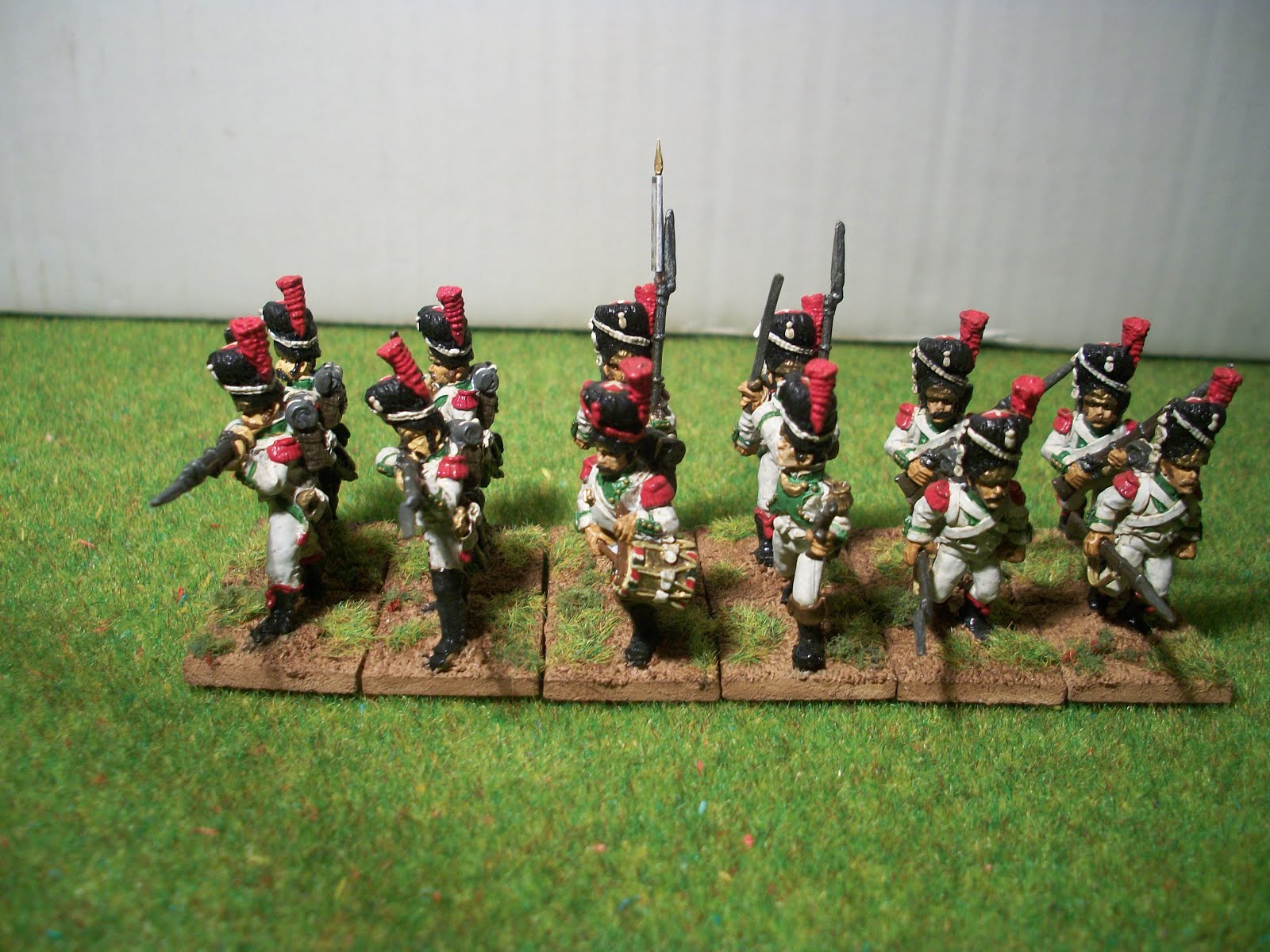
Royal Velites of the Italian Guard

The unit which fought in Catalonia was the Velite Grenadier of the Guard. This unit and a detachment of the Italian Guard Artillery Train were the only Guard Units which entered Catalonia within Duhesme’s Corps.

1808

The battalion was composed of between 407 and 519 men and formed part of the Duhesme Corps, 2nd Division (Pino), 1st Bigade (Millossewitz).

June: First action of El Bruc (06/06). Formed part of the vanguard of the Schwartz brigade (with the 3rd bon of 2nd Swiss regiment) received a severe fusillade from the somatents. First siege of Girona (20/06).

September-November: Small engagement in San Boi de Llobregat (02/09) where 4 officers were killed, Battle of San Cugat (12/10) one officer wounded. A small detachment of 122 men fought in the siege of Rosas (Div. Pino).

December: Engagement at Creu Coberta at the outskirts of Barcelona (5/12). During the battle of Molins de Rei was situated in the left wing guarding the artillery park (21/12.

1809

The battalion fought in the 3rd siege of Girona (2/05 – 11/12). At the end of the year the unit quitted the peninsula to fight in other theaters.

Credits

The miniatures are Wargames Foundry french imperial guard grenadiers and chasseurs that I had in my lead pile from long ago the officer is one of my favourite miniatures. 12 miniatures that form a nice little unit painted with Vallejo paints and The Army Painter shades and varnish.
This unit didn't have a flag so after some research (follow this link for discussion on TMP) and the help of the TMP members Prince of Essling and XV Brigada(who sent me a scan) I decided to make a guidon for the unit.


Sunday, October 14, 2012

The French Foreign Legion during the 1st Carlist War.

As a result of an agreement between liberal Spain and France, the last gave support to Isabella sending the Foreign Legion which fought in Algeria.

1835
The legionnaires from Algeria disembark in Tarragona (19/8) and soon are joined with other recruits from France. At this time it numbers:
- 6 Superior officers
- 123 officers and medics
- 4143 soldiers from Algeria
- 571 soldiers from France (Pau depot)
- 343 horses.

During this year the legion fights in a lot of small actions in the north-western part of Catalonia: Balaguer (29/8), Guimerà (20/9), Granadella (27/9) and Tremp (17/11).

At the end of the year, the legion fights in Arguez in Aragon were the 5th bon. defends the village from a Carlist attack winning with odds of 1 to 10.

1836
Fights in the battle of Arlaban (16-17 /01) and is destined to Pamplona and its fortified lines. At this time, Bernelle creates 3 squadrons of polish lancers, a mountain howitzer battery with French and Spanish artillerist, an engineer company and a medical corps company including a stretcher bearers section (maybe the first one of this type in Spain). The legion is posted in the following places all near Pamplona:
- 1st bon. Zubiri
- 2nd bon. Urdáriz
- 3rd and 4th bons. medical corps, lancers battery and HQ at Larrasoana
- 5th bon. Zuviain
- 6th bon. Zabaldica and Archoriz

3500 Carlist occupy Tirapegui heights (26/4) thus threatening Larrasoana. Bernelle and all the troops there fight during 6 hours retreating in good order. The carlist attack Viscarret (16/5) and Zubiri (3/07) where Bernelle and two bons joints the troops of Brig. Clonard (2 Guard bons and Borbon rgt.) to repel the carlist attack. More Carlist attacks on Puente la Reina (17/7) and Zubiri again (30/7) are stopped thanks to the Legion.

Differences with the government and the lack of pays moved Bernelle to refuse the command of the legion. At first, Colonel Beau nicknamed Lebeau (The handsome) took command until the arrival of Brigadier Conrad (summer 1836). Conrad was loved by all his man as he knew a lot of them and spoke several languages encouraging them in their own mother tongue. Conrad was nicknamed “Der Alte Fritz” and rode a white horse.

At the end of this year the legion fought at Arroniz (14/09), Villalba (19/09) and Allo (21/12).

1837
In January the legion still has 3 infantry bons, the cavalry and the artillery. In March fights at Dos Hermanas (15/03) and Larrainzar (21/03).

When the Royal Expedition departs from the north, the legion is reduced to 2 infantry battalions, 2 cavalry squadrons and a mountain battery of six guns. With those forces starts the persecution of the carlists fighting them at Huesca (24/05) where it had 350 dead and wounded (23% of the total) and Barbastro (02/06) where the liberal legion, now only one battalion of infantry, fought its carlist counterparts in a vicious fight. In this last battle, Conrad was dead.

After this battle, the legion was almost destroyed and the last remnants, under orders of capt. Bazaine were sent to Pamplona as garrison troops where it remained until the end of the war.

In 08/12/1839 the last legionnaires, numbering only 500 were sent back to France.

Miniatures
18 miniatures from Perry painted using Vallejo acrylics and the Army Painter shades and varnish. The flag is from Adolfo Ramos.


Thursday, June 30, 2011

Regimiento Irlandés Ultonia


Fou el tercer i últim regiment d’irlandesos que entrà al servei d’Espanya. El seu renom és “El Inmortal”.

1808

Després d’haver combatut durant la Guerra Gran el regiment queda de guarnició a Girona amb únicament 73 oficials y 351 soldats.

Juny: 1r Setge de Girona. El general Duhesme amb una divisió intenta prendre Girona per sorpresa i ataca la ciutat (19-21/06). El sergent major del regiment Enrique O’Donnell, acompanyat dels granaders i de la milícia de Girona (Cruzada Gerundense) efectua una sortida i rebutja els francesos de les torres de Sant Lluís, Sant Narcís i Sant Daniel. Els francesos es retiren cap a Barcelona.

Juliol-Agost: 2n Setge de Girona (21/07-16/08). En una sortida (16/08) tropes del regiment claven l’artilleria que estava obrint bretxa al castell de Montjuic i provoquen la retirada francesa.

Octubre: El regiment es reorganitzat amb nous reclutes arribant a 300 homes agrupats en dos batallons. Passa a la divisió d’Avantguarda a l’Empordà.

Novembre-Desembre: 8 oficials y 118 homes són enviats a defensar Roses on combaten durant el setge (07/11-05/12). 30 baixes i la resta del destacament feta presonera.

1809

El regiment queda reduït a 213 homes que protegeixen Girona. Un petit destacament és enviat a Tarragona.

3r setge de Girona 2/05-11/12

Juny: Sortida contra els atrinxeraments enemics (17/06). Un destacament creua les línies enemigues, arriba fins a Hostalric i torna a entrar a Girona amb 200 homes de reforç (20/06).

Agost: El mateix destacament torna a sortir fins a Hostalric i amb les tropes que allí hi havia combat a Banyoles (16/08). Aquest destacament no torna a entrar a Girona.

Setembre: Sortida per clavar l’artilleria enemiga (1/09), sortida per protegir l’entrada d’un comboi (05/09). El destacament exterior combat a Bàscara i ajuda a entrar un nou comboi. EL MOMENT DE GLORIA: Durant el que es coneix com El Gran Dia de Girona (19/09) rebutja l’assalt als baluards d’Alemanys i de Santa Llúcia. El Coronel Rodolfo Marshall mort a la bretxa. Les tropes exteriors entren l’últim comboi a la plaça (26/09).

Desembre: El MOMENT DE DESGRÀCIA: Girona es rendeix després d’un setge de més de 5 mesos. Les restes del regiment son fets presoners i internats a França. Es perden tres banderes.

1810

A partir dels destacaments que havien quedat a l’exterior es funda el “Batallón de distinguidos de Ultonia” que combat fins al final de la guerra.

ENGLISH TEXT

It was the third and last Irish regiment that entered in Spanish service. It was nicknamed “The Immortal”.

1808

After having fought in the war against the French Republic, the regiment remained in garrison duty in Girona (Gerona in Spanish) with only 73 officers and 351 soldiers.

June: 1st Siege of Girona. General Duhesme, with one division (mainly Italians), tried a surprise against the city (19-21/06). The mayor of the regiment Enrique O’Donnell, with the grenadiers and the militia (Cruzada Gerundense) makes a sortie and attack the French at the towers of Sant Lluís, Sant Narcís and Sant Daniel. The French retreat towards Barcelona.

July-August: 2nd Siege of Girona (21/07-16/08). In a sortie (16/08) troops of the regiment spike the French artillery which was breaching the walls of Montjuic Castle thus provoking the French retreat.

October: The regiment is reorganized into 300 men grouped in two battalions.

November-December: 8 officers and 118 soldiers are sent to defend Roses (Rosas in Spanish) where they fight during the siege (07/11-05/12). The whole detachment minus 30 dead become prisoners of war.

1809

The regiment is reduced to 213 officers and soldiers in Girona. A tiny detachment is sent to Tarragona.

3rd siege of Girona 2/05-11/12

June: Sortie against the French entrenchments (17/06). A detachment crosses the besieging lines, arrives at the fortress of Hostalric and returns to Girona with 200 men of reinforcements (20/06).

August: The same detachment arrives again at Hostalric and joins the troops there fighting at Banyoles (16/08). The detachment remains outside the city of Girona.

September: Sortie to spike the French artillery (1/09), sortie to protect a supply train that enters the city (05/09). The outer detachment fights at Bàscara helping in the entrance of a new supply train. MOMENT OF GLORY: During what is known as the Great Day of Girona (19/09) defends the bastions of Alemanys and Santa Llúcia against the French assault. The colonel Rodolfo Marshall dies in the breach. The outer troops enter the last supply train into the city (26/09).

December: MOMENT OF DISGRACE: Girona surrenders after a long siege (more than 5 months). What remains of the regiment is made prisoner of war. Three flags are lost to the enemy.

1810

With the detachments that remained outside the city and new recruits the new regiment “Batallón de Distinguidos de Ultonia” is founded. The regiment fights until the end of the war.